How to Build a Reliable Costbook for Consistent Estimates
A strong costbook gives your remodeling business a repeatable foundation for faster estimating, more accurate pricing, and stronger profit control.
If your estimates vary depending on who builds them, or if your team still relies on scattered spreadsheets and outdated pricing, you are not just risking inconsistency. You are risking profit.
A reliable costbook is the foundation of every successful remodeling estimate. It helps your business price jobs consistently, apply margins correctly, reduce rework, and present customers with confidence.
What Is a Costbook?
A costbook is a structured database of the materials, labor, assemblies, pricing, and margins your business uses to create estimates. Instead of rebuilding pricing from memory or copying old spreadsheets, your team works from a trusted source of cost data.
For remodeling contractors, a costbook helps standardize how estimates are built so every job follows the same pricing logic and profitability rules.
A reliable costbook may include:
- Materials and supplier pricing
- Labor rates and production assumptions
- Reusable assemblies and grouped scopes of work
- Markup and margin rules
- Consistent categories for easier estimating
Why Costbook Reliability Matters
In remodeling, small pricing errors can become big profit problems. If one estimator prices labor differently than another, or if material costs are outdated, the business may not notice the issue until the job is already underway.
Reliable costbooks create consistent estimates. Consistent estimates create better expectations, stronger margins, and fewer surprises after the contract is signed.
Without a reliable costbook, contractors often struggle with:
- Underpriced work
- Missed scope items
- Inconsistent customer proposals
- Poor visibility into expected profit
- Time wasted rebuilding estimate data
How to Build a Reliable Costbook
1. Standardize Your Costbook Structure
Start by organizing your costbook into clear categories that match how your business estimates work.
Common categories may include:
- Demo
- Framing
- Electrical
- Plumbing
- Drywall
- Flooring
- Cabinets
- Countertops
- Painting
- Finishes
- Labor
When your costbook is organized consistently, your team can find items faster and build estimates with fewer errors.
2. Use Real Costs Instead of Guesswork
A costbook is only as reliable as the numbers inside it. Your pricing should be based on real supplier costs, labor rates, production history, and actual job experience.
The goal is to reduce guessing and make estimating repeatable.
Reliable costs help you:
- Price jobs more accurately
- Protect margins
- Reduce underbidding
- Improve confidence before sending a proposal
3. Build Assemblies for Repeatable Work
Assemblies are groups of related items that can be reused across estimates. Instead of adding every material and labor line manually, an assembly lets you add a complete scope of work quickly.
For example, a bathroom remodel assembly might include:
- Demo labor
- Plumbing rough-in
- Electrical updates
- Tile labor
- Fixtures
- Finish materials
Assemblies save time, reduce missed items, and help your team estimate similar work the same way every time.
4. Apply Margins Consistently
Profitability depends on more than cost. Your costbook should support consistent margin and markup rules so every estimate is priced with your business goals in mind.
Consistent margin control helps you:
- Avoid underpriced jobs
- Improve profit visibility
- Set pricing standards across the team
- Understand expected profitability before the contract is signed
5. Keep Your Costbook Updated
A costbook should not be treated as a one-time setup task. Material costs, labor rates, supplier pricing, and market conditions change over time.
Reviewing and updating your costbook regularly keeps your estimates accurate and helps your business stay profitable.
How Remodel Cloud Supports Reliable Costbooks
Remodel Cloud is designed to help remodeling contractors move away from scattered spreadsheets and build estimates from a structured, connected system.
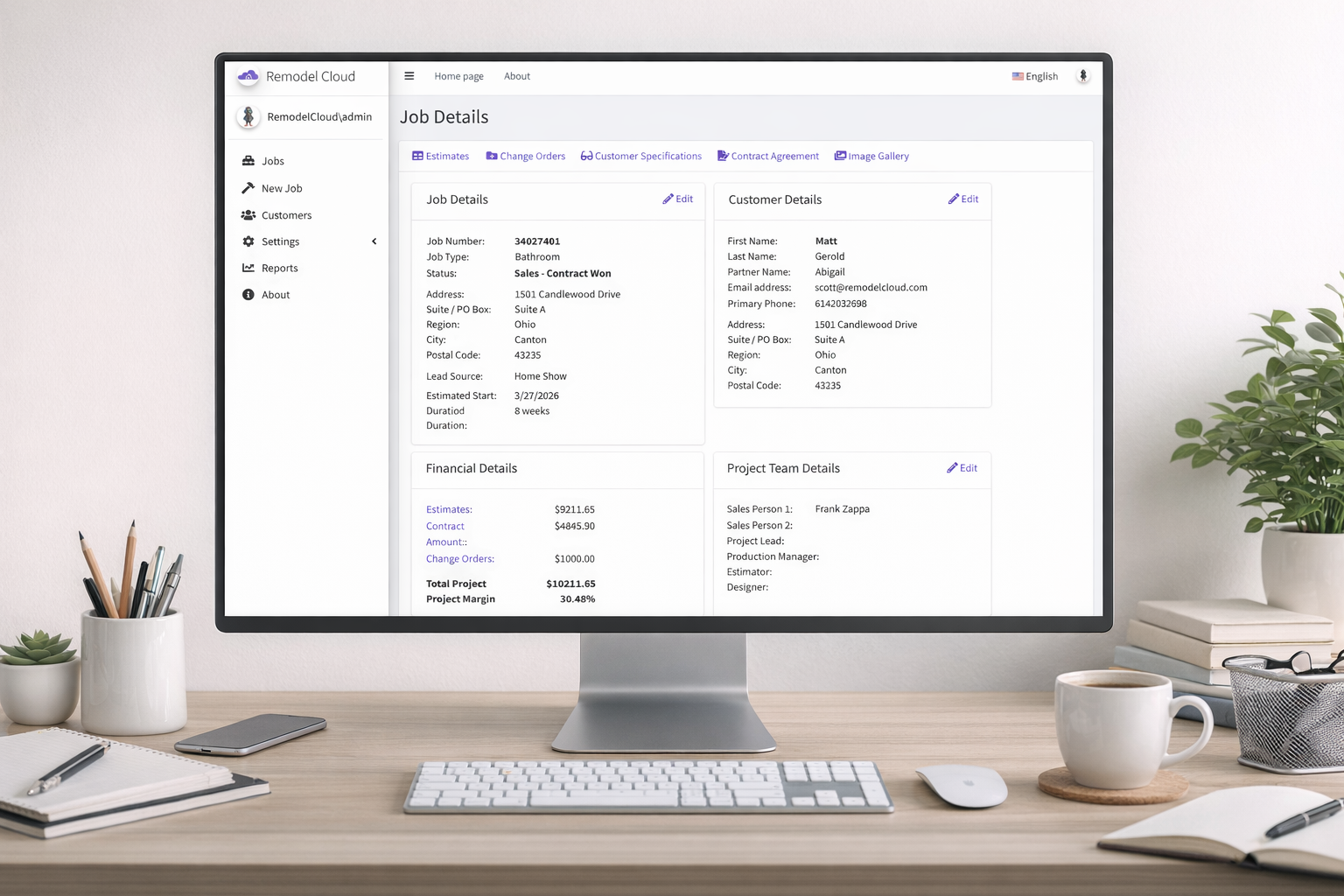
With Remodel Cloud, your costbook becomes more than a list of prices. It becomes part of your estimating workflow, contract process, change order tracking, and financial visibility.
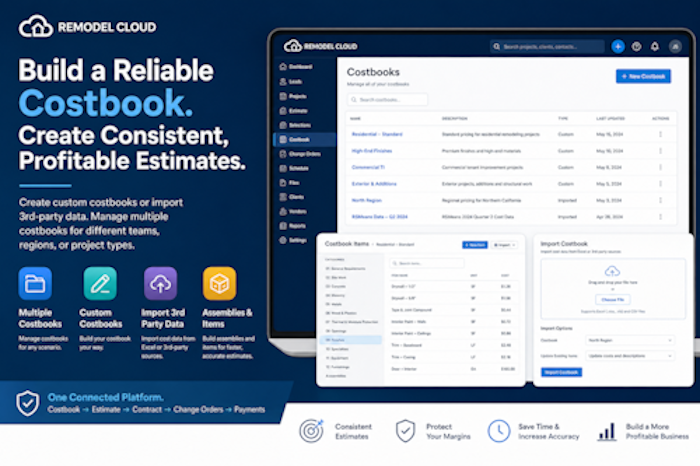
Support for Multiple Costbooks
Not every job, team, or market uses the same pricing structure. Remodel Cloud supports multiple costbooks so your business can organize pricing in a way that fits how you actually work.
You may use multiple costbooks for:
- Different project types
- Different locations or regions
- Different divisions or teams
- Residential vs. commercial work
- Standard vs. premium pricing models
This gives your business more flexibility while still keeping estimating consistent and controlled.
Custom Costbooks Built Around Your Business
Remodel Cloud allows you to create and manage custom costbooks based on your own pricing, categories, labor assumptions, and estimating process.
That means you are not forced into a rigid structure that does not match your business.
You can build costbooks around:
- Your preferred categories
- Your own labor rates
- Your supplier pricing
- Your standard scopes of work
- Your margin strategy
Your costbook should reflect the way your company actually estimates. Remodel Cloud helps make that possible.
Import Third-Party Costbooks and Existing Data
If you already have cost data from another system, supplier, or third-party source, Remodel Cloud can support importing costbook data instead of forcing you to rebuild everything manually.
This is especially useful if you already rely on:
- Supplier pricing files
- Third-party construction cost data
- Existing spreadsheets
- Legacy estimating data
- Company-specific pricing lists
The import feature helps you get up and running faster while preserving the pricing data your business already trusts.
Assemblies Help Speed Up Estimating
Remodel Cloud supports assemblies so your team can reuse common scopes of work instead of rebuilding them line by line.
Assemblies help your business:
- Estimate faster
- Reduce missed items
- Standardize repeatable work
- Improve accuracy across estimators
- Keep estimates consistent from job to job
For remodeling contractors, this can make a major difference in both speed and profitability.
Costbook Data Flows Into the Full Job Lifecycle
One of the biggest advantages of Remodel Cloud is that your costbook does not sit in isolation.
Your costbook supports the estimating process, and that estimate can continue into the rest of the job workflow.
With Remodel Cloud, your data can flow from:
- Costbook
- Estimate
- Contract
- Change orders
- Invoices and payments
- Job financial tracking
This reduces duplicate entry, prevents errors, and keeps your job information connected.
The Business Impact of a Reliable Costbook
When your costbook is reliable and your estimating process is consistent, your business gains more control.
A strong costbook helps you:
- Build estimates faster
- Price jobs more accurately
- Protect profit margins
- Reduce estimating mistakes
- Standardize team workflows
- Improve customer confidence
- Scale your business with less chaos
For remodelers trying to grow, this level of consistency is critical.
Final Thoughts
A reliable costbook is not just an estimating tool. It is a foundation for running a more consistent, profitable, and scalable remodeling business.
Spreadsheets may work when your business is small, but as your team grows, disconnected pricing and inconsistent estimating can quickly create costly problems.
Remodel Cloud helps contractors build better estimates by supporting:
- Multiple costbooks
- Custom costbooks
- Third-party costbook imports
- Reusable assemblies
- Margin control
- Connected estimating and job workflows
If you want estimates your team can trust, start with a costbook that is organized, accurate, and built for the way your remodeling business works.
Ready to Build More Consistent Estimates?
Remodel Cloud helps remodeling contractors create reliable estimates, manage costbooks, control margins, and carry job data from estimate to final payment.